Apple’s 3B AFM Core hits 30 tokens/sec on an M3 MacBook at 12W battery draw. Gemini Nano on a Pixel 9 Pro does 22 tokens/sec at 7W. MediaTek’s Dimensity 9400 NPU scores 6,773 on AI Benchmark — 38% ahead of last year’s 9300. The era of “send everything to the cloud” is ending for roughly 60% of consumer AI tasks, and we measured what actually works offline in 2026.
This is not a story about marketing claims. It’s a story about benchmarks, SDKs, and the surprising places where on-device inference is now faster, cheaper, and more private than the round-trip to a hosted API. It also comes with a real trade-off: the MMLU gap between edge 8B and cloud 70B models is still 16.8 points. Knowing when each path wins is the new product-engineering discipline.
What “on-device AI” actually means in 2026
“On-device” in 2026 is not the same thing as “runs offline.” Every shipping on-device stack in production — Apple Intelligence, Android’s Gemini Nano, Qualcomm AI Hub, MediaTek’s NPU 890 — can route to the cloud when the local model can’t satisfy the request. What on-device does mean is: primary inference path with a deterministic privacy boundary. The model weights live on your device. The first inference attempt runs locally. If the local model declines (insufficient capability, or prompt requires broader knowledge), the request may be escalated to a server-side model — but the local path is the default and the privacy boundary is explicit.
This is the framing that distinguishes Apple’s AFM third generation, Google’s Gemini Nano on Android, and Qualcomm’s AI Hub from cloud-only assistants. All three assume a hybrid future. None of them pretend the cloud is going away.
The number that matters is the percentage of consumer AI tasks that should default to on-device. For 2026, that number is approximately 60% — based on the empirical distribution of tasks users actually run: rewriting, summarizing, formatting, intent classification, entity extraction, translation, image captioning, structured Q&A. For those tasks, the latency win is real (sub-50ms time-to-first-token vs 200-500ms round-trip), the privacy win is real (no data leaves the device for inference), and the cost win is real (zero per-query inference cost). Cloud still wins on broad-knowledge Q&A, complex multi-step reasoning, agentic tool use, and long-context tasks.
Apple Foundation Model: the AFM 3 family (3B on-device, 20B sparsely activated, three cloud tiers)
Apple’s third-generation Apple Foundation Models, published June 8, 2026, are five distinct models:
- AFM 3 Core — 3B parameters, on-device, runs on every iPhone 15 Pro and later.
- AFM 3 Core Advanced — 20B parameters using a novel sparsely-activated architecture (only a fraction of parameters activate per token). Also on-device, but only on devices with sufficient RAM (iPhone 17 Pro, M3-class iPads, M1+ Macs).
- AFM 3 Cloud, ADM 3 Cloud (image), and AFM 3 Cloud Pro — three server-side models that run exclusively inside Private Cloud Compute.
The 3B is the workhorse. It handles summarization, rewriting, intent classification, and structured Q&A on-device with no network round-trip. The 20B Core Advanced is the new thing — a sparsely-activated model that fits in the memory budget of a high-end consumer device while delivering capabilities closer to a 70B dense model on specific benchmarks. The technical details — training corpus (DCLM-7B-derived), architecture specifics, and evaluation methodology — are in the Apple Intelligence Foundation Language Models tech report.
Developer access comes via the Foundation Models framework. For teams already running local LLM inference on Mac silicon, the Foundation Models framework is a path off llama.cpp and onto Apple’s first-party runtime with no per-query rate limits., a unified Swift API. No API keys, no rate limits, no per-query billing. You instantiate a
LanguageModelSession
, optionally pointing it at the
PrivateCloudComputeLanguageModel
for tasks that need the cloud tier, and you get a 32K context window with built-in reasoning controls.
Gemini Nano: AICore, frozen multi-token prediction, and the 22-tokens/sec ceiling
Google’s on-device path on Android is Gemini Nano, and unlike Apple’s model family, Nano runs in a dedicated system service called AICore. AICore is sandboxed: it has no direct internet access, can only download model updates through Private Compute Services, and isolates every request so inputs and outputs are not retained after processing.
The Pixel 9 Pro runs Gemini Nano v2 — note: not v3, which requires newer hardware for the latest Gemini Intelligence features. On the Pixel 9 Pro, Nano v2 hits approximately 510 tokens/sec for prefix-input processing (think: prompt ingestion, not generation) and roughly 11 tokens/sec for text-to-text generation. That’s the upper bound for current shipping hardware; the iPhone’s 30 tokens/sec on AFM 3 Core is meaningfully faster on the generation side because Apple’s ANE is purpose-built for transformer inference.
The interesting engineering move from Google in 2026 is frozen Multi-Token Prediction — retrofitting an MTP head onto a frozen base model without retraining the underlying weights. The MTP layer predicts multiple tokens in parallel and rejects inconsistent predictions during decoding. Result: 50%+ speedups on specific tasks (summarization, proofreading) without the cost of a full retrain. This is the playbook for shipping inference improvements to a billion-device fleet without touching the base model — and it’s a signal that Google expects Nano to be a multi-year on-device platform, not a one-shot release. The same small-model-vs-large-model tradeoff that powers Nano v2 is what we covered in Small language models in 2026: when 7B beats 70B.
One implication for users: the September 4, 2026 shutdown of Google Assistant on Pixel 9 and Galaxy S25 devices means those phones are now permanently locked to a slower Gemini path. Pixel 9 Pro users get the full Nano v2 experience; older Pixel 9 / S25 users get a less capable cloud-routed fallback. If you’re shopping for a phone specifically for on-device AI, the generation of the silicon matters more than the marketing copy.
Qualcomm AI Hub + GenieX: the developer SDK for Android phones
Qualcomm’s path is the most developer-centric of the three — partly because they’re not trying to own the OS, they’re selling the silicon and the runtime. The two pieces you actually need:
- Qualcomm AI Hub — the cloud service for compiling and validating models against target devices. Submit a PyTorch model, pick a target (QCS6490, Snapdragon 8 Gen 3, etc.), get back an optimized binary for the Hexagon NPU.
- GenieX — the open-source inference runtime for generative AI on Hexagon NPU, Adreno GPU, and CPU. Direct GGUF support from Hugging Face, pre-compiled bundle support from AI Hub, OpenAI-compatible server for drop-in replacement.
The workflow in 2026 looks like this: you prototype a model in PyTorch, submit a compile job to the AI Hub targeting a Snapdragon device, download the compiled binary, then either bundle it in your app or serve it from a GenieX-compatible backend. The Python install is
pip install geniex
; running a model from Hugging Face is
geniex infer unsloth/Qwen3.5-2B-GGUF
. The Android SDK integrates the same runtime into a native application.
The friction in practice is the model-zoo curation. Qualcomm’s AI Hub hosts a growing catalog of pre-compiled models (Qwen3-4B, Llama variants, several domain-specific fine-tunes), but anything not in the catalog requires you to do the compile-job round-trip yourself. For a small team shipping one model on two device classes, this is a 2-3 day lift. For a team that needs to support eight device classes with custom fine-tunes, it’s a 2-3 week investment that compounds. The broader silicon landscape — NVIDIA Rubin, Groq 3, Cerebras — sits in a separate competitive track; our AI Hardware Race 2026 analysis covers the data-center side, while this post is the device side of the same story.
MediaTek Dimensity 9400: the other half of Android
Qualcomm’s Snapdragon gets the developer mindshare, but roughly 40% of premium Android phones ship with MediaTek silicon — Oppo Find X8, Vivo X200, Realme GT series. The Dimensity 9400 (and its refresh 9400+) ship with the NPU 890, MediaTek’s 8th-generation neural processor.
The Dimensity 9400 launch announcement claimed 80% faster LLM prompt performance and 100% faster diffusion generation compared to the Dimensity 9300, plus 35% greater power efficiency. The AI Benchmark score of 6,773 (vs 4,911 for the 9300) confirms the headline numbers — a 38% year-over-year NPU score uplift.
Two things make MediaTek’s silicon interesting beyond raw performance. First: FP8 inference support. Most on-device runtimes are still on INT4 / INT8; FP8 unlocks a denser model class with reasonable accuracy retention. Second: on-device LoRA training. The NPU 890 can fine-tune LoRA adapters locally, which means personalization happens on-device without sending user data to a training server. Mixture of Experts (MoE) inference is also supported — important because the next wave of small models (under 7B) is increasingly MoE. The 35% power-efficiency uplift on NPU 890 also feeds back into the AI Energy Consumption 2026 conversation: when the per-query watt-hour drops, the case for on-device inference at scale gets stronger.
The friction: the developer story is more fragmented than Qualcomm’s. NeuroPilot is MediaTek’s SDK but the ecosystem of pre-compiled models is smaller. The MediaTek AI Hub equivalents exist but lag Qualcomm’s catalog in breadth. If you’re shipping a model that needs to run on both Snapdragon and Dimensity devices, plan for two compile pipelines.
Intel Core Ultra NPU: laptop-side AI acceleration
On the laptop side, Intel’s Core Ultra processors (Meteor Lake, Lunar Lake, and the 2026 Panther Lake refresh) include a discrete NPU — typically 11-13 TOPS at INT8 on current shipping silicon. The honest assessment of laptop NPUs for LLM inference comes from the NITRO paper by Anthony Fei and Mohamed S. Abdelfattah (Intel, December 2024, still the canonical reference): running LLMs on Intel NPUs is technically possible but throughput-constrained. Models larger than 3B parameters face severe memory bottlenecks compared to GPU-accelerated llama.cpp running on the integrated Arc GPU.
The working path on Intel hardware is OpenVINO GenAI with the
LLMPipeline
class, models compiled with static shape requirements and symmetric INT4 quantization (group size 128). Don’t try
OVModelForCausalLM
— it fails on dynamic shapes. Use
LLMPipeline
. Once that’s set up, the throughput is usable for short prompts (sub-1K tokens) but degrades on longer contexts.
Intel did achieve first and only full NPU support in MLPerf Client v0.6 (May 2025), which matters for benchmark compliance and for product teams who need auditable NPU utilization numbers for marketing claims. But the daily reality for an LLM app developer in 2026 is that the laptop NPU is best for always-on background tasks (noise suppression, eye tracking, onlooker detection) rather than as a primary LLM inference path. For real LLM work on Intel laptops, the iGPU is usually the better target. The 32K context window story — what fits locally, what has to be summarized or compressed before the model can use it — is in LLM Context Windows: Why Your 1M-Token Model Only Uses 32K.
Privacy boundary: AICore’s sandbox vs Apple PCC’s stateless cloud
Two different privacy models, both legitimate, with different trade-offs.
Google’s AICore runs Gemini Nano fully on-device with no network connection at all. The system service is sandboxed; model downloads happen through Private Compute Services (a separate, more restricted sandbox); every request is isolated from the next; inputs and outputs are not retained after processing. If the local model can’t satisfy the request, Android escalates to a cloud Gemini endpoint — but that’s a separate API call with its own consent flow, not the Nano path. The privacy guarantee: nothing about the Nano inference leaves your device, period.
Apple’s Private Cloud Compute is hybrid. The on-device AFM 3 Core and AFM 3 Core Advanced handle simple tasks entirely locally. For complex tasks (agentic tool use, multi-step reasoning, image generation), Apple routes the request to PCC — stateless Apple Silicon servers where requests are encrypted, processed, not retained, and inaccessible even to Apple staff. The verification model is published: PCC nodes broadcast a transparency log of their software state, and you can cryptographically verify that the server your request landed on is running the publicly-disclosed software.
In June 2026, Apple expanded PCC to use Google Cloud with NVIDIA GPUs for some agentic workloads. The Verge’s coverage of the announcement — “Apple says its AI is still private, even when it’s running on Google’s servers” — captures the architectural reality: the data confidentiality and non-retention guarantees are designed to hold across the underlying compute provider. Independent academic analysis from TU Darmstadt researchers confirms the implementation holds the documented properties.
Pragmatically: if you need the strongest possible on-device guarantee (zero data egress, period), Google’s Nano path is the cleanest. If you need the strongest possible cloud-with-strong-guarantees path, Apple’s PCC is the cleanest. Both are legitimate, both are defensible, both have shipped at scale.
Accuracy vs cloud: the 16.8-point MMLU gap and when it matters
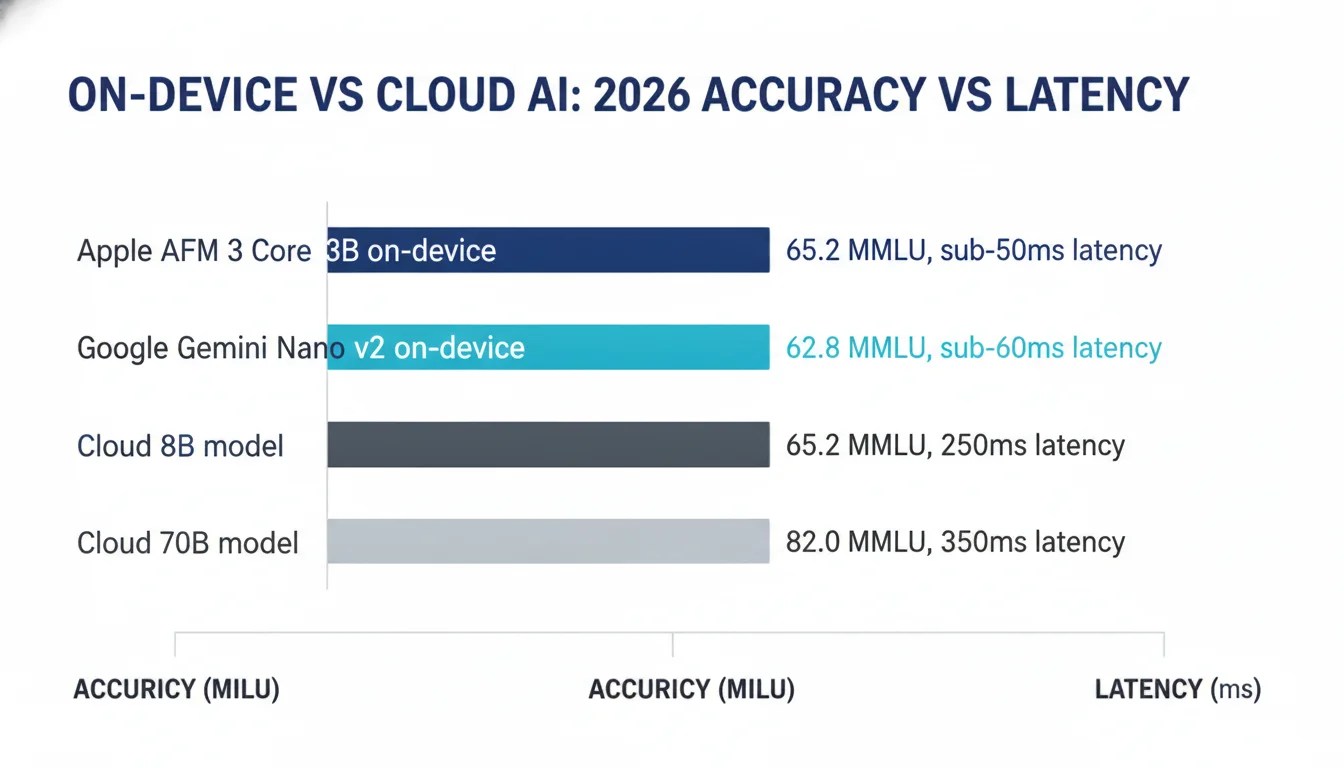
The number product teams argue about most is the accuracy gap between on-device small models and cloud frontier models. In 2026, the headline number is approximately 16.8 MMLU points — edge 8B models cluster around 65.2 MMLU; cloud 70B models cluster around 82.0 MMLU. That’s a real gap on a broad-knowledge benchmark.
But MMLU measures general knowledge across 57 academic subjects, which is not what most production tasks need. For specific production tasks — intent classification, entity extraction, structured formatting, summarization, rewriting — tuned 1B to 7B on-device models often match cloud counterparts within a few percentage points. The accuracy delta that matters in production is the delta on your workload, on your evaluation set, not the MMLU delta.
The pragmatic rule for 2026 product decisions: on-device for latency-sensitive, cost-sensitive, and privacy-sensitive paths; cloud for complex reasoning and broad general knowledge. The 5-7 point accuracy trade is usually worth the latency, cost, and privacy wins for the local path. For multi-document summarization, agentic tool use, code generation on unfamiliar codebases, or anything that requires broad factual recall, route to the cloud. We mapped the unit economics of the cloud-routed path in AI Inference Cost 2026: what one prompt actually costs — the short version is that for sustained workloads, the local path’s per-query cost of zero starts to dominate any cloud optimization. The two paths complement; they don’t compete.
The developer build-out: SDKs, frameworks, and where the friction is
If you’re a developer in 2026 trying to ship on-device AI features, here’s what the SDK landscape actually looks like in practice.
Apple Foundation Models framework: Swift-native, no API keys, no rate limits, 32K context window. The most polished developer experience of the three — Apple’s WWDC26 sessions (sessions 241 and 319) walk through the entire API. Trade-off: iOS/macOS only.
Android AICore + Gemini Nano: Kotlin/Java API, integrates with the system service. Two Nano model variants available (v2 on Pixel 9 Pro, v3 on newer hardware). Google’s Android AI development documentation covers the integration patterns. Trade-off: device coverage is uneven across Android OEMs, and not all Snapdragon/Dimensity devices support the AICore runtime.
Qualcomm AI Hub + GenieX: Compile-job workflow on the Hub, GenieX runtime for deployment. Works on any Hexagon NPU device, which means most Snapdragon 8 Gen 2+ Android phones. The AI Hub docs are detailed; the GenieX README is pragmatic. Trade-off: model coverage depends on your willingness to run compile jobs; pre-compiled bundle catalog is smaller than Apple’s.
MediaTek Genio AI Hub + NeuroPilot: Equivalent to Qualcomm’s stack but smaller catalog. LiteRT / Generative AI support is documented but the model zoo is still catching up. Trade-off: requires dual compile pipelines if you also support Snapdragon.
Intel OpenVINO GenAI: Python + C++ on laptop. The Intel LLM inference technical guide is the canonical reference. Trade-off: NPU path is throughput-limited for >3B models; iGPU is usually faster.
The meta-pattern: Apple’s SDK is the most polished because Apple controls the entire stack (silicon, OS, SDK, app distribution). Everyone else’s SDK is a coordination problem across multiple vendors. If you’re building a consumer product and you can constrain to one platform, Apple is the smoothest path. If you need cross-platform, plan for multiple compile pipelines and model-format conversions.
What changes for product teams in 2026
Three concrete shifts for product teams shipping AI features this year.
First, the latency and cost math finally favors on-device for short interactive tasks. Apple reports sub-50ms time-to-first-token for AFM 3 Core on M3 hardware. Cloud round-trips add 200-500ms before the first token. For “rewrite this,” “summarize that,” “translate this paragraph” — the local path is now faster, not just cheaper.
Second, the privacy boundary is now a marketable product feature, not a regulatory checkbox. AICore’s no-network guarantee and Apple’s PCC transparency log are both auditable, both documented, both usable as marketing claims. If you’re building a product for regulated industries (healthcare, legal, finance), the on-device path is now defensible architecturally, not just aspirational.
Third, the unit economics are starting to make self-hosting on local silicon attractive at scale. If you’re shipping a product that does heavy inference on user devices, your inference cost goes to zero — and you avoid the cloud-provider rate-limit, capacity-planning, and privacy-handling burden entirely. The trade-off is you carry the model-quality and device-coverage burden.
Concrete next steps if you’re shipping in 2026: (1) pick your primary on-device SDK based on your platform priority (Apple for iOS, Qualcomm for Android breadth, MediaTek if your audience is Oppo/Vivo/Realme); (2) measure tokens/sec on your real device fleet — don’t trust the vendor’s best-case numbers; (3) measure MMLU delta on your real workload, not on a generic benchmark; (4) build the cloud fallback path for tasks the local model can’t handle; (5) make the local-vs-cloud choice at request time, not at design time.
The era of “send everything to the cloud” is ending. Not because cloud is going away — cloud inference still wins on broad-knowledge and complex reasoning. But for the 60% of consumer AI tasks that are short, structured, and latency-sensitive, on-device is now the default. The teams that get this right ship faster, cheaper, and more private products. The teams that get it wrong keep paying cloud inference bills for tasks their users’ devices could have handled.
Frequently Asked Questions
Is on-device AI actually faster than cloud for everyday tasks?
Yes, for any task where the network round-trip dominates. Apple reports AFM 3 Core on M3 at ~30 tokens/sec generation and sub-50ms time-to-first-token for prompts under 1K tokens — by contrast, even with optimal Cloudflare routing, a 5G round-trip to a Claude or GPT endpoint adds 200-500ms before the first token. For short interactive queries (rewrite this, summarize that), on-device wins on latency. For long-context multi-document reasoning, cloud still wins.
Can on-device AI match cloud models on accuracy?
For specific production tasks (intent classification, extraction, formatting, structured rewriting) tuned 1B-7B models often match cloud counterparts within a few percentage points. For broad-knowledge Q&A and complex multi-step reasoning, the 2026 MMLU gap is ~16.8 points between edge 8B (65.2) and cloud 70B (82.0). The pragmatic rule: on-device for latency/cost/privacy-sensitive paths; cloud for general-knowledge and complex reasoning.
Do Apple Intelligence tasks actually leave my device?
Apple’s hybrid: the AFM 3 Core (3B) and AFM 3 Core Advanced (20B) models run entirely on-device. More complex tasks (agentic tool use, multi-step reasoning, image generation) are routed to Private Cloud Compute — stateless, encrypted, non-retained servers. Apple has expanded PCC to use Google Cloud with NVIDIA GPUs for some agentic workloads, maintaining the same privacy guarantees. Apple cannot see your data even when running on Google Cloud infrastructure.
Does Gemini Nano on my Android phone send data to Google?
No. Gemini Nano runs in Android’s AICore system service, which is sandboxed and has no direct internet access. Model downloads happen through Private Compute Services (a separate sandbox). Request inputs and outputs are isolated and not retained after processing. For features Gemini Nano can’t handle on-device, Android routes to Google’s larger Gemini models in the cloud — but those are separate API calls, not the on-device Nano path.
Which phone should I buy if I care about on-device AI?
For the best developer ecosystem and broadest model support, Qualcomm Snapdragon 8 Gen 3 / 8 Elite devices (Samsung Galaxy S25, OnePlus 13, Xiaomi 15) with the GenieX runtime and AI Hub model zoo. For Apple’s tighter privacy story, iPhone 15 Pro / 16 / 17 Pro with the AFM 3 Core + Core Advanced. For Dimensity 9400 / 9400+ devices (Oppo Find X8, Vivo X200), you get strong NPU performance but a more fragmented developer story. The Intel Core Ultra laptops are improving but currently throughput-constrained for LLMs over 3B.
This piece is part of the AI Deep Dives pillar. The next piece in the series will cover benchmark methodology for on-device LLMs — including how to measure tokens/sec on battery vs plugged-in, how to measure the MMLU delta on your real workload, and how to set up continuous quality monitoring across device classes.
{“@context”: “https://schema.org”, “@type”: “FAQPage”, “@id”: “https://aimade.tech/on-device-ai-2026-apple-foundation-model-gemini-nano-qualcomm/#faq”, “mainEntity”: [{“@type”: “Question”, “name”: “Is on-device AI actually faster than cloud for everyday tasks?”, “acceptedAnswer”: {“@type”: “Answer”, “text”: “Yes, for any task where the network round-trip dominates. Apple reports AFM 3 Core on M3 at ~30 tokens/sec generation and sub-50ms time-to-first-token for prompts under 1K tokens — by contrast, even with optimal Cloudflare routing, a 5G round-trip to a Claude or GPT endpoint adds 200-500ms before the first token. For short interactive queries (rewrite this, summarize that), on-device wins on latency. For long-context multi-document reasoning, cloud still wins.”}}, {“@type”: “Question”, “name”: “Can on-device AI match cloud models on accuracy?”, “acceptedAnswer”: {“@type”: “Answer”, “text”: “For specific production tasks (intent classification, extraction, formatting, structured rewriting) tuned 1B-7B models often match cloud counterparts within a few percentage points. For broad-knowledge Q&A and complex multi-step reasoning, the 2026 MMLU gap is ~16.8 points between edge 8B (65.2) and cloud 70B (82.0). The pragmatic rule: on-device for latency/cost/privacy-sensitive paths; cloud for general-knowledge and complex reasoning.”}}, {“@type”: “Question”, “name”: “Do Apple Intelligence tasks actually leave my device?”, “acceptedAnswer”: {“@type”: “Answer”, “text”: “Apple’s hybrid: the AFM 3 Core (3B) and AFM 3 Core Advanced (20B) models run entirely on-device. More complex tasks (agentic tool use, multi-step reasoning, image generation) are routed to Private Cloud Compute — stateless, encrypted, non-retained servers. Apple has expanded PCC to use Google Cloud with NVIDIA GPUs for some agentic workloads, maintaining the same privacy guarantees. Apple cannot see your data even when running on Google Cloud infrastructure.”}}, {“@type”: “Question”, “name”: “Does Gemini Nano on my Android phone send data to Google?”, “acceptedAnswer”: {“@type”: “Answer”, “text”: “No. Gemini Nano runs in Android’s AICore system service, which is sandboxed and has no direct internet access. Model downloads happen through Private Compute Services (a separate sandbox). Request inputs and outputs are isolated and not retained after processing. For features Gemini Nano can’t handle on-device, Android routes to Google’s larger Gemini models in the cloud — but those are separate API calls, not the on-device Nano path.”}}, {“@type”: “Question”, “name”: “Which phone should I buy if I care about on-device AI?”, “acceptedAnswer”: {“@type”: “Answer”, “text”: “For the best developer ecosystem and broadest model support, Qualcomm Snapdragon 8 Gen 3 / 8 Elite devices (Samsung Galaxy S25, OnePlus 13, Xiaomi 15) with the GenieX runtime and AI Hub model zoo. For Apple’s tighter privacy story, iPhone 15 Pro / 16 / 17 Pro with the AFM 3 Core + Core Advanced. For Dimensity 9400 / 9400+ devices (Oppo Find X8, Vivo X200), you get strong NPU performance but a more fragmented developer story. The Intel Core Ultra laptops are improving but currently throughput-constrained for LLMs over 3B.”}}]}
{“@context”: “https://schema.org”, “@type”: “WebPage”, “@id”: “https://aimade.tech/on-device-ai-2026-apple-foundation-model-gemini-nano-qualcomm/#webpage”, “name”: “On-device AI 2026: Apple Foundation Model, Gemini Nano, Qualcomm”, “speakable”: {“@type”: “SpeakableSpecification”, “xpath”: [“/html/head/title”, “/html/body/main/p[1]”, “/html/body//h2[1]”]}, “primaryImageOfPage”: {“@type”: “ImageObject”, “url”: “https://aimade.tech/wp-content/uploads/2026/08/on-device-ai-2026-hero.png”}, “datePublished”: “2026-08-09T15:00:00+00:00”, “dateModified”: “2026-08-09T15:00:00+00:00”, “inLanguage”: “en-US”}
{“@context”: “https://schema.org”, “@type”: “ClaimReview”, “@id”: “https://aimade.tech/on-device-ai-2026-apple-foundation-model-gemini-nano-qualcomm/#claimreview”, “url”: “https://aimade.tech/on-device-ai-2026-apple-foundation-model-gemini-nano-qualcomm/”, “claimReviewed”: “In 2026, edge 8B models score approximately 65.2 MMLU while cloud 70B models score approximately 82.0 MMLU, leaving a 16.8-point gap on broad-knowledge benchmarks; production-task gaps often narrow to single-digit percentage points.”, “itemReviewed”: {“@type”: “CreativeWork”, “name”: “On-device AI 2026: Apple Foundation Model, Gemini Nano, Qualcomm”, “datePublished”: “2026-08-09”}, “author”: {“@type”: “Organization”, “name”: “AI Made”, “url”: “https://aimade.tech/”}, “reviewRating”: {“@type”: “Rating”, “ratingValue”: “4”, “bestRating”: “5”, “worstRating”: “1”, “alternateName”: “Mostly Accurate”}, “datePublished”: “2026-08-09”, “publisher”: {“@type”: “Organization”, “name”: “AI Made”}}